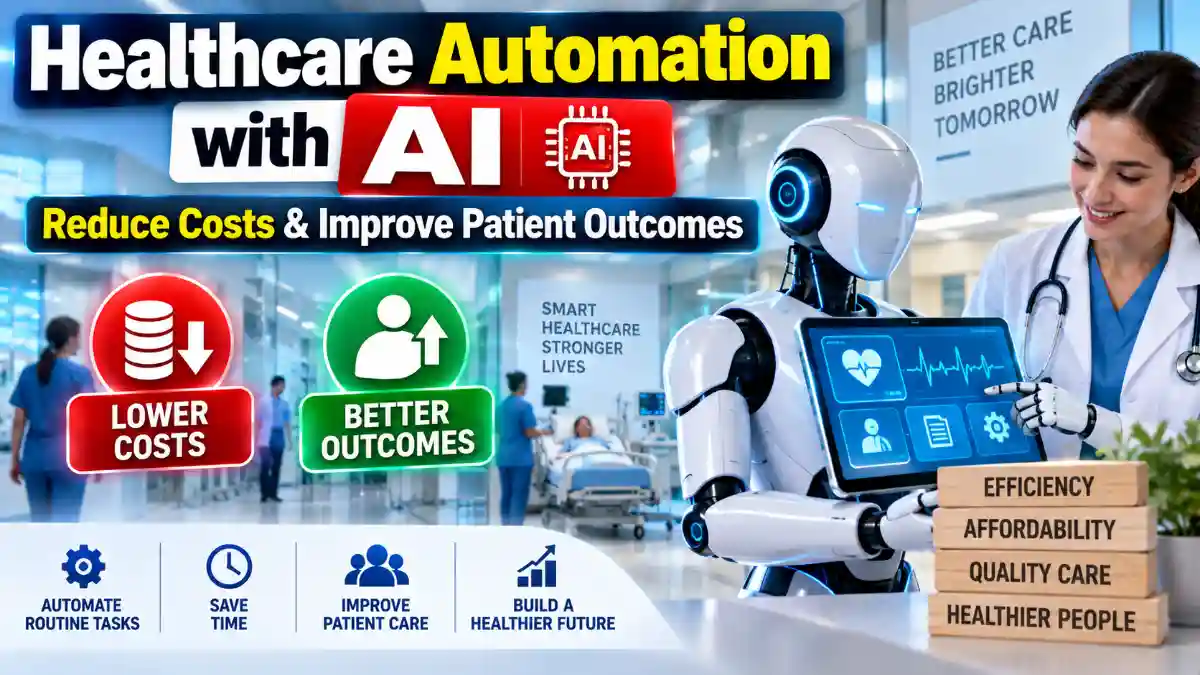
Healthcare systems around the world are under constant pressure. Rising costs, staff shortages, and growing patient volumes have pushed hospitals and clinics to look for smarter ways to operate. This is where healthcare automation with AI comes in. By combining artificial intelligence with automated workflows, healthcare providers can cut operational costs, reduce human error, and — most importantly — deliver better outcomes for patients.
In this article, we’ll break down what healthcare automation with AI actually means, where it’s already making an impact, and why it’s becoming a necessity rather than a luxury for modern healthcare organizations.
What Is Healthcare Automation with AI?
Healthcare automation with AI refers to the use of artificial intelligence, machine learning, and robotic process automation (RPA) to handle tasks that were traditionally done manually. This includes everything from scheduling appointments and processing insurance claims to analyzing medical scans and predicting patient risk factors.
Unlike simple software automation, AI-powered systems can learn from data, adapt to new situations, and make decisions with a level of accuracy that continues to improve over time. This makes them especially valuable in healthcare, where speed, accuracy, and consistency can directly affect patient safety.
Key Areas Where AI Is Transforming Healthcare
1. Administrative Automation
A large portion of healthcare spending goes toward administrative work — scheduling, billing, documentation, and compliance reporting. AI-driven tools can now handle appointment scheduling, send automated reminders, and even manage patient intake forms without human intervention.
This doesn’t just save time. It frees up front-desk staff and administrators to focus on tasks that genuinely require human judgment, while reducing the risk of scheduling errors or missed follow-ups.
2. Medical Diagnostics
AI-powered diagnostic tools are increasingly used to analyze X-rays, MRIs, CT scans, and pathology slides. These systems can flag abnormalities faster than manual review in many cases, helping doctors catch conditions like tumors, fractures, or cardiovascular issues earlier.
It’s important to note that AI doesn’t replace doctors here — it acts as a second set of eyes, helping clinicians prioritize urgent cases and reduce diagnostic delays.
3. Remote Patient Monitoring
Wearable devices and connected health sensors, combined with AI algorithms, allow healthcare providers to monitor patients remotely in real time. This is particularly valuable for chronic disease management, where continuous tracking of vitals like heart rate, blood pressure, or glucose levels can prevent emergencies before they happen.
Instead of waiting for a scheduled visit, care teams can be alerted the moment a patient’s data shows a concerning trend, allowing for faster intervention.
4. Automated Billing and Claims Processing
Medical billing is notoriously complex, with errors leading to delayed payments and revenue loss. AI-based systems can automatically verify insurance eligibility, flag coding errors, and process claims faster than traditional manual review.
This reduces claim denials, speeds up reimbursement cycles, and cuts down on the administrative overhead that healthcare organizations typically spend on billing departments.
5. Drug Discovery and Research
Pharmaceutical companies are using AI to accelerate drug discovery, cutting years off traditional research timelines. Machine learning models can analyze massive datasets to identify promising drug compounds, predict potential side effects, and optimize clinical trial design.
While this may not directly touch day-to-day hospital operations, it plays a major role in bringing new treatments to patients faster and at a lower overall cost.
How AI Reduces Healthcare Costs
Cost reduction is one of the biggest reasons healthcare organizations are investing in automation. Here’s how AI helps lower expenses across the system:
- Fewer administrative errors — Automated data entry and claims processing reduce costly billing mistakes.
- Optimized staffing — Predictive analytics help hospitals forecast patient volume, avoiding both overstaffing and understaffing.
- Reduced hospital readmissions — AI-driven risk prediction models identify high-risk patients before discharge, allowing for better follow-up care that prevents costly readmissions.
- Faster diagnostics — Quicker, more accurate diagnoses reduce the need for repeat tests and unnecessary procedures.
- Lower operational overhead — Automating repetitive tasks means fewer staff hours spent on manual paperwork.
According to various industry studies, healthcare organizations that adopt AI-driven automation report measurable reductions in administrative costs and operational inefficiencies within the first year of implementation.
Improving Patient Outcomes with AI
Cost savings are important, but the real value of healthcare automation lies in better patient care. Here’s how AI directly improves outcomes:
Earlier disease detection. AI algorithms trained on large medical imaging datasets can detect subtle patterns that might be missed during a routine manual review, leading to earlier intervention for conditions like cancer or heart disease.
Personalized treatment plans. By analyzing a patient’s medical history, genetic data, and lifestyle factors, AI can help clinicians design more personalized treatment plans rather than relying on a one-size-fits-all approach.
Reduced medical errors. Automation reduces the risk of human error in areas like medication dosing, patient data entry, and treatment scheduling — all of which can have serious consequences if mishandled manually.
Faster emergency response. In emergency departments, AI triage tools help prioritize patients based on the severity of their condition, ensuring critical cases are seen faster.
Better chronic disease management. Continuous monitoring and predictive alerts allow care teams to intervene before a chronic condition worsens, improving long-term health outcomes and quality of life.
Challenges and Considerations
Healthcare automation with AI isn’t without its challenges. Organizations need to consider:
- Data privacy and security — Patient data is highly sensitive, and AI systems must comply with regulations like HIPAA to protect it.
- Integration with legacy systems — Many hospitals still rely on outdated software, making AI integration technically challenging.
- Staff training — Clinicians and administrative staff need proper training to work alongside AI tools effectively.
- Algorithm bias — AI models are only as good as the data they’re trained on, so organizations must actively monitor for bias that could affect diagnostic accuracy across different patient populations.
- Regulatory approval — Medical AI tools often require regulatory clearance before they can be used in clinical settings, which can slow adoption.
Addressing these challenges requires a thoughtful, phased approach rather than a rushed rollout — starting with lower-risk administrative automation before moving into clinical decision support.
The Future of AI in Healthcare
Looking ahead, healthcare automation is expected to become even more deeply integrated into everyday clinical workflows. Predictive analytics will play a bigger role in preventive care, AI-powered virtual health assistants will handle more patient interactions, and robotic process automation will continue to streamline back-office operations.
As AI models become more accurate and healthcare organizations gain more experience deploying them responsibly, the gap between early adopters and traditional providers is likely to widen. Organizations that invest in AI-driven automation now are positioning themselves for both financial sustainability and improved patient care in the years ahead.
Conclusion
Healthcare automation with AI isn’t about replacing doctors and nurses — it’s about giving them better tools to do their jobs more effectively. From reducing administrative burden to catching diseases earlier and personalizing treatment, AI is reshaping what efficient, patient-centered healthcare looks like.
For healthcare organizations weighing the investment, the evidence is clear: AI-driven automation offers a practical path to lowering costs while genuinely improving the quality of care patients receive. The organizations that start integrating these tools thoughtfully today will be the ones best equipped to handle the healthcare demands of tomorrow.