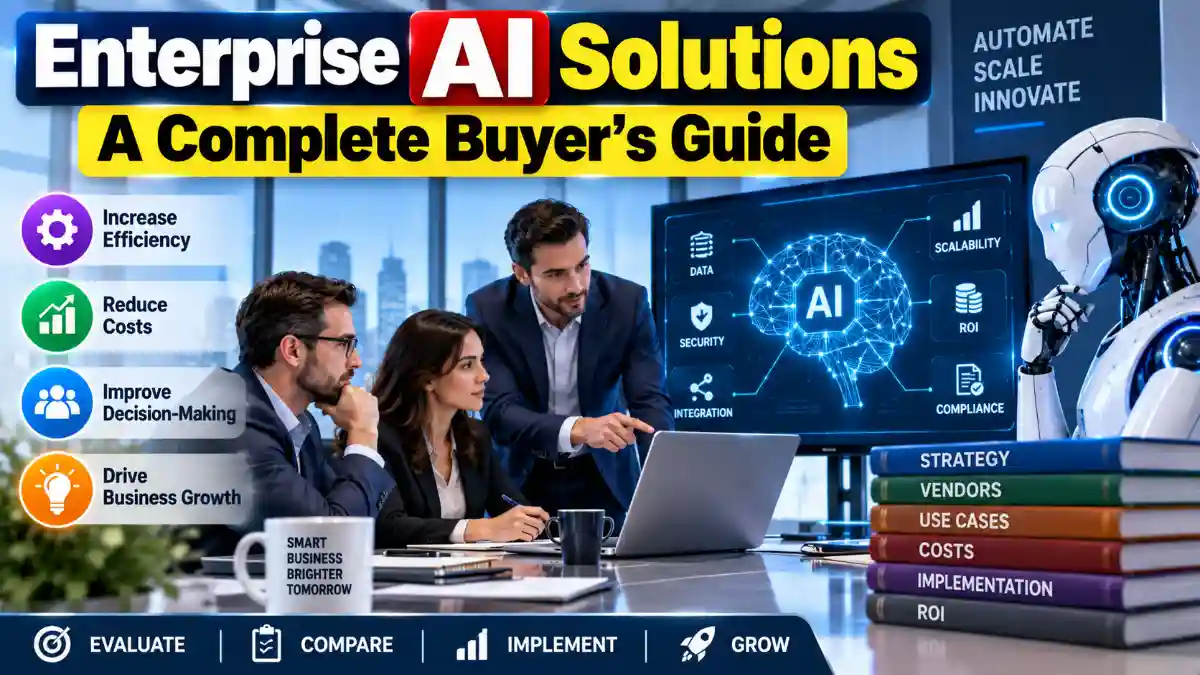
Artificial intelligence has moved from an experimental side project to a core part of how large organizations operate. Yet with hundreds of vendors, dozens of deployment models, and a constant stream of new features, choosing the right enterprise AI solution has become one of the most confusing purchasing decisions a business leader will face this decade. This guide breaks down what enterprise AI actually means, what to look for, and how to avoid the costly mistakes that trip up even experienced buyers.
What Are Enterprise AI Solutions?
Enterprise AI solutions are software platforms and tools built specifically to help large organizations automate workflows, analyze data, and make faster decisions using machine learning and generative AI. Unlike consumer AI tools, enterprise-grade systems are designed around three non-negotiable requirements: security, scalability, and integration with existing business systems.
These solutions typically fall into a few broad categories:
- Generative AI platforms – tools for content creation, coding assistance, and conversational agents
- Predictive analytics and forecasting tools – used in supply chain, finance, and sales planning
- Process automation platforms – combining AI with robotic process automation (RPA) to handle repetitive tasks
- Customer experience AI – chatbots, virtual agents, and personalization engines
- Data intelligence platforms – tools that clean, structure, and extract insights from unstructured data
Understanding which category actually solves your business problem is the first step before you even start evaluating vendors.
Why Enterprises Are Investing in AI Now
The push toward enterprise AI adoption isn’t just about staying trendy. Organizations are under real pressure to cut operational costs, respond faster to market changes, and extract more value from the data they already collect. AI systems that once required massive in-house data science teams are now available as ready-to-deploy platforms, lowering the barrier to entry significantly.
At the same time, competitive pressure plays a role. When competitors automate customer support, speed up reporting cycles, or personalize marketing at scale, businesses that lag behind risk losing both efficiency and market share. This urgency, however, is exactly why a structured buying process matters — rushed AI purchases are one of the leading causes of failed implementations.
Key Factors to Evaluate Before Buying
1. Data Security and Compliance
Enterprise AI tools often require access to sensitive company data, from customer records to financial information. Before signing any contract, confirm the vendor’s compliance certifications (such as SOC 2, ISO 27001, or GDPR alignment where relevant), and ask specifically how your data is stored, encrypted, and whether it’s used to train the vendor’s models. This last point matters more than most buyers realize — some platforms use client data for model training by default unless you opt out.
2. Integration With Existing Systems
An AI tool is only as useful as its ability to connect with the systems your teams already rely on — CRM platforms, ERP software, data warehouses, and communication tools. Ask vendors for a list of pre-built integrations and API documentation. Solutions that require heavy custom development to connect basic systems will slow down adoption and increase total cost of ownership.
3. Scalability
A tool that works well for a 50-person pilot team may behave very differently once rolled out across 5,000 employees or millions of customer interactions. Look for platforms with a proven track record at enterprise scale, and ask vendors directly for case studies involving organizations similar in size to yours.
4. Customization and Flexibility
Off-the-shelf AI models rarely fit every business perfectly. Evaluate whether the platform allows fine-tuning, custom model training, or configurable workflows so the tool can adapt to your industry’s specific terminology, processes, and regulatory requirements.
5. Total Cost of Ownership
Pricing models for enterprise AI vary widely — per-seat licensing, usage-based pricing, or flat enterprise contracts. Beyond the sticker price, factor in implementation costs, training time, ongoing support fees, and the cost of any additional infrastructure needed to run the solution.
6. Vendor Support and Roadmap
AI technology evolves quickly, and the vendor you choose today should be investing in continuous improvement. Ask about their product roadmap, update frequency, and what dedicated support looks like post-purchase — not just during the sales process.
Common Mistakes to Avoid
Many organizations fall into predictable traps when evaluating AI vendors:
- Buying based on hype rather than fit – The most talked-about AI tool isn’t necessarily the right one for your workflows.
- Skipping a proof of concept – Rolling out a solution company-wide without first testing it on a smaller scale often leads to costly rework.
- Ignoring change management – Even the best AI tool fails if employees don’t understand how or why to use it.
- Underestimating data readiness – AI systems perform only as well as the data feeding them. Messy, siloed, or incomplete data will limit results regardless of how advanced the model is.
- Overlooking long-term costs – Usage-based pricing can spiral quickly as adoption grows across the organization.
Steps to Choosing the Right Enterprise AI Solution
- Define the business problem clearly. Avoid starting with “we need AI” and instead identify the specific inefficiency, cost, or bottleneck you’re trying to solve.
- Shortlist vendors based on use case fit, not just brand recognition.
- Request a pilot or sandbox trial with your own data before committing.
- Involve IT, security, and legal teams early in the evaluation process, not after a contract is signed.
- Calculate ROI based on measurable outcomes — time saved, error reduction, revenue impact — rather than vague productivity claims.
- Plan for training and adoption, since even the best tool underperforms without proper onboarding.
The Future of Enterprise AI
Looking ahead, enterprise AI is shifting toward more autonomous, agentic systems capable of completing multi-step tasks with minimal human oversight, alongside tighter integration between AI tools and everyday business software. Buyers who build a strong evaluation framework now will be better positioned to adopt these next-generation capabilities without having to overhaul their entire tech stack later.
Conclusion
Choosing an enterprise AI solution isn’t just a technology decision — it’s a strategic one that touches security, operations, finance, and company culture. The organizations that get the most value from AI aren’t necessarily the ones that move fastest, but the ones that evaluate carefully, test thoroughly, and choose tools that genuinely fit their business needs rather than chasing the latest trend.
By focusing on data security, integration, scalability, and real measurable outcomes, businesses can avoid the common pitfalls of AI adoption and select a solution that delivers lasting value.